When you’re missing one tooth or an entire arch, your dentist may present different replacement options; this includes dental implants, dental bridges, and dentures. Each suits different clinical situations and comes with its own set of benefits. At Steele Oral Surgery, we offer various services, including wisdom teeth removal and implants. Here are some comparisons of implants vs. bridges vs. dentures:
Reviewing Tooth Replacement Options
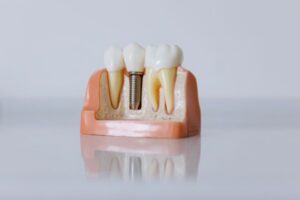
Dentists recommend restoration options based on the number of damaged or missing teeth and the severity of the condition. A dental implant replaces both the root and the crown of a missing tooth. A professional places a titanium post into the jawbone, and once it heals, a custom restoration is attached on top. Because the implant is anchored into the bone itself, it functions like a natural tooth in terms of stability and bite strength.
A dental bridge fills a gap by anchoring an artificial tooth to the natural teeth on either side of the space. The neighboring teeth must be filed down to serve as anchors; this results in a permanent alteration. Bridges sit above the gumline and do not interact with the jawbone.
Traditional dentures offer removable appliances that rest on the gums. They are held in place by natural suction, metal clasps, or adhesive. A full denture replaces an entire arch of teeth, and a partial denture fills in gaps among remaining natural teeth. At Steele Oral Surgery, our team completes all restoration preparation, including wisdom teeth removal if necessary.
Understanding the Jawbone’s Role
When a tooth root is no longer present, the surrounding bone begins to deteriorate and be absorbed into the body. Implants are the only replacement option that addresses this directly. The titanium post stimulates the jawbone the same way a natural root does, and this helps prevent further bone loss and maintain the face’s shape over time.
A bridge spans the gap but leaves the bone beneath the artificial tooth without any functional load. Traditional dentures rest on the gumline, and as the bone beneath continues to resorb, the fit of the denture will change over time. These options may require periodic adjustments or new appliances.
Choosing Implant Dentures
Implant dentures work by anchoring a full denture to three to six implant posts rather than relying on suction or adhesive; they can be designed as either fixed or removable. Fixed implant dentures stay in the mouth at all times and require more jawbone density to support the greater number of implants. Removable implant dentures use clips or ball sockets that allow the patient to take them out for cleaning. They typically require fewer implants, making them accessible to patients with some degree of bone loss.
Use Services Like Wisdom Teeth Removal
The right oral restoration choice depends on your current oral health and long-term goals for function. Implants provide a structure similar to natural teeth, but they require surgery and adequate healing time. Bridges offer a solution for single-tooth gaps but could alter healthy adjacent teeth. Though traditional dentures are an accessible option, they often require ongoing management. At Steele Oral Surgery, we offer complimentary consultations that assess bone density, gum health, and overall oral condition. Contact us today to schedule an appointment.